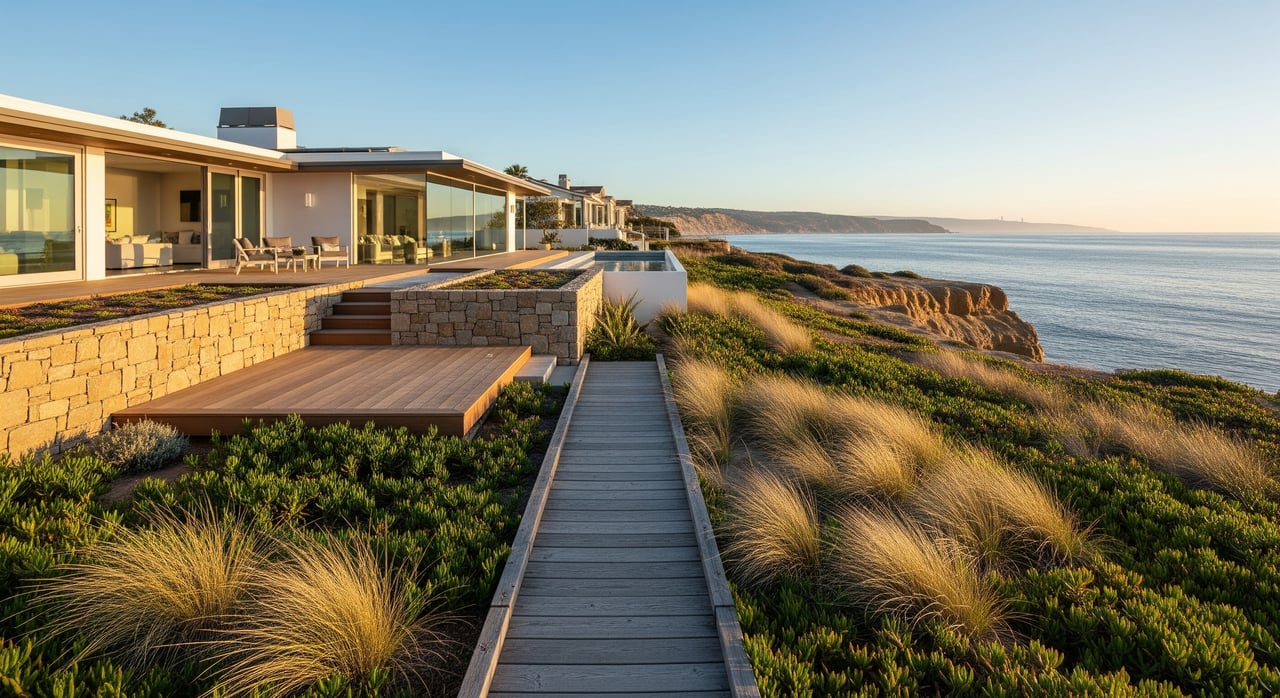
Thinking about a bluff-top or ocean-view home in Dana Point? These properties are special, and so are the rules that shape what you can build or change. Understanding coastal setbacks and permits early can save you time, money, and stress. In this guide, you’ll learn how setbacks work, who approves what, which reports you’ll need, and how to spot red flags before you commit. Let’s dive in.
What a coastal setback means
A coastal setback is a required distance between a structure and the bluff edge or shoreline. The goal is to reduce risk from erosion, landslides, waves, and rising seas. Setbacks help keep homes on stable ground over the life of the structure.
In practice, setbacks are based on site-specific science. You can expect a licensed coastal geotechnical professional to study the bluff, calculate retreat rates, and recommend a setback that reflects your planned building lifespan with a safety buffer.
How permits work in Dana Point
The City of Dana Point Planning Division is the primary local reviewer for coastal projects. Most projects in the coastal zone need a Coastal Development Permit, along with standard building permits. Start by contacting the City through the official City of Dana Point website.
The California Coastal Commission oversees the Coastal Act statewide and certifies Local Coastal Programs. In some cases, the Commission may handle appeals or retain permit authority. You can learn more about its role on the California Coastal Commission site.
Always confirm the current Local Coastal Program status and whether your property is in an appeal area. The City and the Coastal Commission can clarify who has final authority for your project.
How setbacks are determined
Setbacks are not one-size-fits-all. They are based on your property’s conditions and the design life of the structure.
Bluff retreat rates
Your geotechnical report will analyze historical imagery and prior studies to estimate how fast the bluff retreats over time. That retreat rate is multiplied by a planning horizon to set a baseline distance.
Design life and buffers
The report will state the design life used and explain the method behind the setback calculation. A safety buffer is added to account for uncertainty, groundwater, and seismic factors. Drainage and landscaping recommendations often follow to maintain stability.
Shoreline armoring is limited
Seawalls, revetments, and bulkheads are highly regulated and often discouraged unless there is no feasible alternative. If armoring is proposed, it typically requires special findings and mitigation. Review the Coastal Commission’s general guidance and permit information on the Coastal Commission site.
Your due diligence checklist
Before you write an offer or plan a remodel, cover these essentials:
- Ask the seller for past permits, geotechnical and coastal engineering reports, and any recorded notices or restrictions.
- Request a pre-application conversation with Dana Point Planning to confirm permit history and likely approvals for your intended changes. Start with the City of Dana Point site.
- Order a current boundary and topographic survey that maps the bluff edge and existing structures.
- Commission a reconnaissance by a coastal geotechnical professional to flag immediate hazards and inform insurability and lender questions.
- Review FEMA flood zones for your location using the FEMA Flood Map Service Center.
- Explore sea-level rise scenarios using the NOAA Sea Level Rise Viewer. For state guidance, see the California Ocean Protection Council.
- Confirm availability and cost of homeowners, flood, and hazard insurance. Ask your lender about collateral requirements for bluff-top properties.
- Identify any existing or adjacent shoreline armoring and whether maintenance or removal obligations exist.
The permit path, step by step
Here is the typical sequence for coastal bluff projects in Dana Point:
- Pre-application. Meet with City Planning to clarify permit triggers, submittal requirements, and timelines.
- Site studies. Prepare a survey and geotechnical report. Add coastal engineering, visual, and biological studies if required.
- Application. Submit plans, reports, fees, and environmental materials for review.
- Public review. Expect notifications to neighbors and possible hearings.
- Decision and appeals. The City may approve with conditions or deny. Some actions are appealable to the California Coastal Commission.
- Post-permit. Secure building permits, follow monitoring and mitigation conditions, and record any required notices.
Typical timeframes vary. Geotechnical studies often take 1 to 3 months. Discretionary reviews can take several months, and appeals can add additional months.
The specialists you will need
Hiring the right team early reduces surprises and speeds decisions:
- Coastal geotechnical engineer or geologist
- Coastal engineer for wave runup and shoreline processes when needed
- Licensed surveyor to establish the bluff edge accurately
- Architect or structural engineer with coastal experience and LCP familiarity
- Environmental consultant if habitat or wetlands are involved
- Coastal land-use attorney or permit consultant for complex cases
- Insurance broker and lender experienced in coastal properties
Costs, timing, and resale impacts
Permitting, mandatory mitigation, and potential denial risk can affect what you can build and how long it takes. Insurance can be more expensive for bluff-top homes, and some coverage may be limited. Lenders may request current geotechnical documentation or avoid properties with imminent hazard. Over decades, erosion and sea-level rise can reduce usable lot area and may be noted in disclosures.
Red flags to pause or reconsider
Proceed with caution if you see any of the following:
- No geotechnical history and visible signs of recent slumping or retreat
- Unpermitted or temporary shoreline armoring on or near the site
- Recorded notices of imminent hazard or future removal requirements
- A project that appears to need hard armoring as the only feasible protective measure
Smart mitigation options
When hard armoring is not feasible or allowed, consider non-structural strategies:
- Increase setbacks or relocate structures away from the bluff edge
- Use elevated foundations and improve site drainage to manage water
- Favor soft landscaping that stabilizes soils without adding weight
- Plan for managed retreat if long-term projections indicate future risk
Planning your next move
If a Dana Point bluff-top home is on your shortlist, invest in the right studies before you finalize your offer. Start with City Planning, assemble your technical team, review FEMA and NOAA resources, and pressure test your timeline and budget. Clear, early steps give you better leverage during negotiations and a smoother path once you own the property.
Ready to explore options or stress-test a property you’re considering? Connect with Brian Sperry for a strategy-first consultation tailored to coastal Orange County.
FAQs
What is a coastal setback and why does it matter in Dana Point?
- A coastal setback is the required distance between a structure and the bluff edge or shoreline to reduce erosion, landslide, and wave risks over the life of the structure.
Who approves coastal development permits in Dana Point?
- The City of Dana Point typically issues local Coastal Development Permits, and the California Coastal Commission may review appeals or retain authority in specific areas or circumstances.
How long do permits and studies usually take for bluff-top projects?
- Geotechnical studies often take 1 to 3 months, and discretionary reviews commonly take several months, with appeals adding additional months.
Can I build a seawall or revetment to protect my property?
- Shoreline armoring is highly regulated and often discouraged unless no feasible alternative exists, and it requires strict findings and mitigation.
What technical reports will I likely need for a remodel or rebuild?
- Expect a survey and a geotechnical report with setback calculations; some sites also need coastal engineering, visual, and environmental studies.
Where can I check flood zones and sea-level rise for my address?
- Use the FEMA Flood Map Service Center for flood zones and the NOAA Sea Level Rise Viewer for sea-level rise scenarios; state guidance is available from the California Ocean Protection Council.